Gerald Wilde
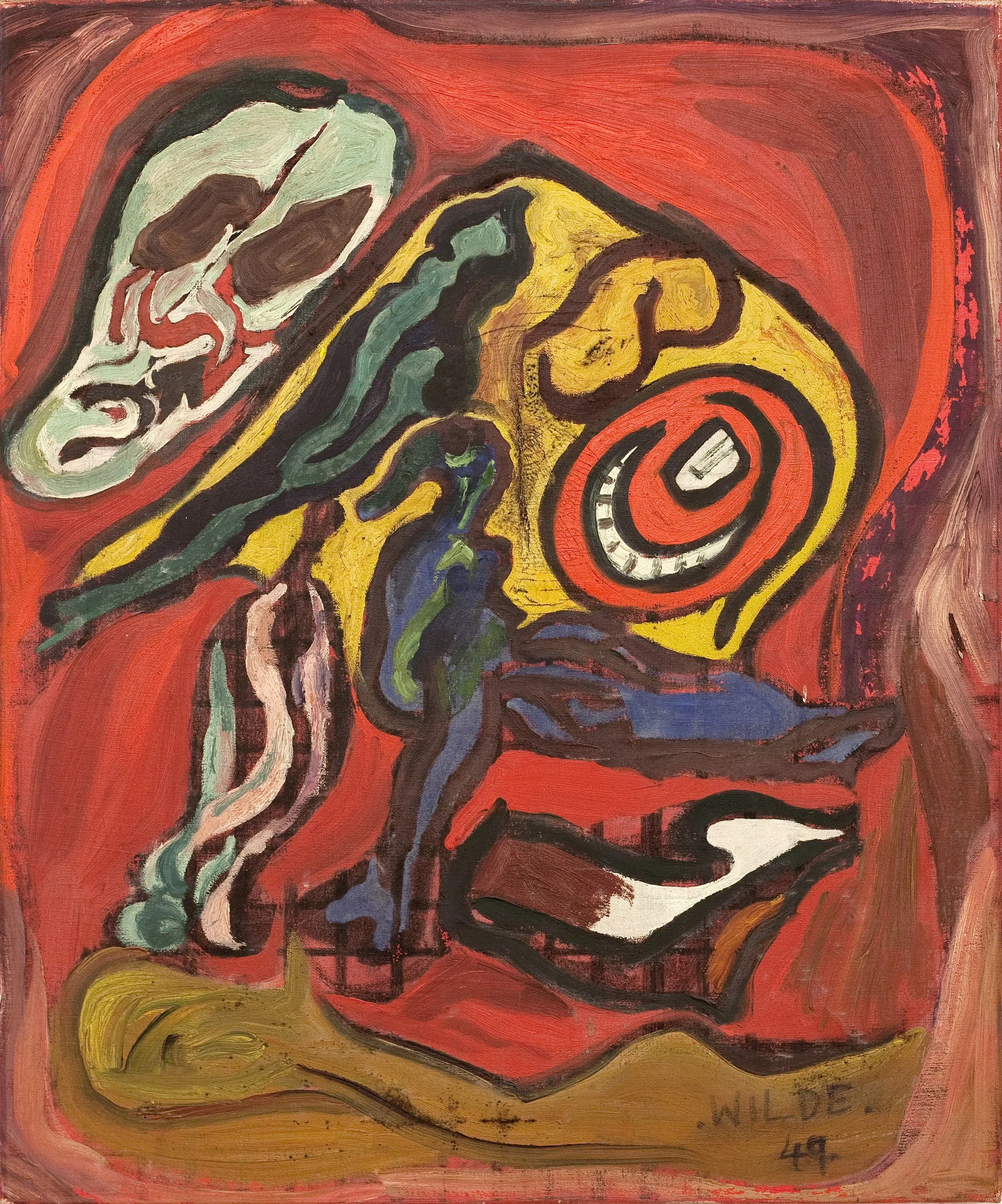
Gerald Wilde (1905–1986) was a singular figure in British modernism, whose intensely expressive paintings and drawings occupied the space between figuration and abstraction. Born in London, Wilde studied at Chelsea School of Art, where he was taught by Graham Sutherland and became a lifelong friend of Henry Moore. His work drew on Cubism, Surrealism and German Expressionism, developing into a distinctive visual language of vivid colour, fractured forms and dreamlike imagery.
Admired by artists including Lucian Freud and Frank Auerbach, and championed by critics such as John Berger and David Sylvester, Wilde nevertheless remained an outsider to the British art establishment. His early work was largely destroyed during the Blitz, and periods of ill health interrupted his practice. Following major exhibitions at the Hanover Gallery in 1948 and the ICA in 1955, Wilde experienced a long period away from painting before returning to produce some of his most dynamic work in the 1970s and 1980s.
Wilde's work is characterised by a restless tension between chaos and control, with figures, landscapes and abstract forms emerging from energetic lines and saturated fields of colour. Despite his considerable influence and the recognition of his peers, he remained relatively underappreciated during his lifetime. Today, his work is held in collections including Tate and the Arts Council Collection, and he is increasingly recognised as an important and highly individual voice in twentieth-century British art.